




On this page
See Tech Prescient in Action
Automate access, reduce risk, and stay audit-ready
RBAC and ABAC are two of the most widely used access control models in modern identity security. The key difference between RBAC and ABAC lies in how access decisions are made: RBAC grants access based on predefined user roles, while ABAC evaluates real-time attributes such as user context, device, location, and time.
Organizations comparing RBAC vs ABAC are typically choosing between simplicity and flexibility. RBAC works best in structured environments with stable job roles, while ABAC is better suited for Zero Trust, hybrid, and cloud-native environments that require dynamic, context-aware access decisions. In this guide, we break down RBAC vs ABAC, explain their strengths and limitations, and help you determine whether a hybrid approach makes the most sense for your organization.

Key Takeaways
- RBAC is role-focused and well-suited for organizations with clearly defined roles and responsibilities.
- ABAC enables dynamic, real-time access decisions based on attributes such as location, time, and device context.
- Both RBAC and ABAC support least-privilege access and foundational identity governance controls.
- Hybrid access management models that combine RBAC and ABAC provide the flexibility required in modern, dynamic enterprise environments.
- The best model for your access management requirements is based on organizational scale, compliance requirements, and infrastructure complexity.
- Understanding the differences between these access models helps organizations design a secure, scalable access control strategy.
What is Role-Based Access Control (RBAC)?
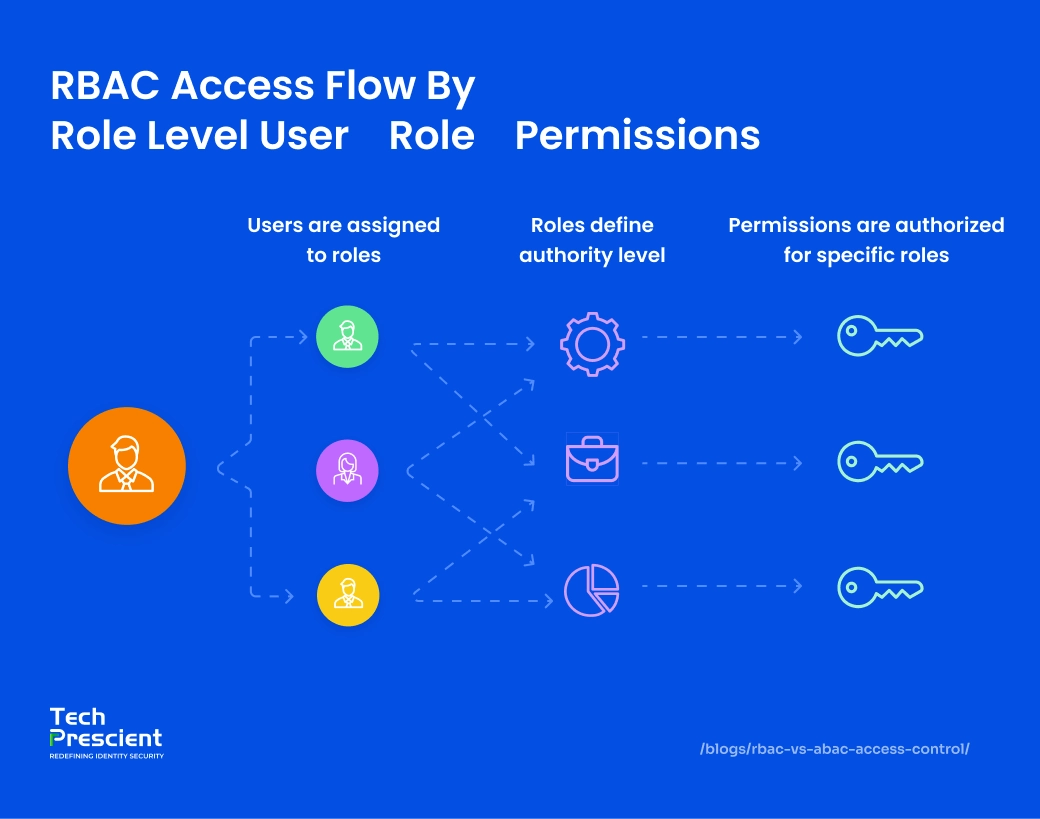
Role-Based Access Control (RBAC) is one of the most adopted approaches for governing access in enterprise environments. With RBAC, access is granted according to the user’s role in the organization, which generally corresponds with their job function. Each role includes a set of permissions that help you easily provide users access so that they can perform their jobs.
For example:
- Admin - Has full control over systems, application configurations, and user management.
- HR - Has access to employee records, payroll applications, and recruiting and hiring platforms.
- Sales - Has access to a customer relationship management (CRM) tool, sales dashboards, and customer data.
- IT Support - Has permission to troubleshoot system issues, reset user passwords, and manage help desk tickets.
This model typically works best in a structured organization with clear job responsibilities. RBAC is relatively simple to implement and audit, and aligns well with regulatory requirements such as SOX, HIPAA, and GDPR. It is magnified by organizations with nuanced user needs and growth that allows for tens of thousands of roles. As organizations grow, managing large numbers of roles can lead to overlap, redundancy, and unintentionally over-permissioned users.
What is Attribute-Based Access Control (ABAC)?
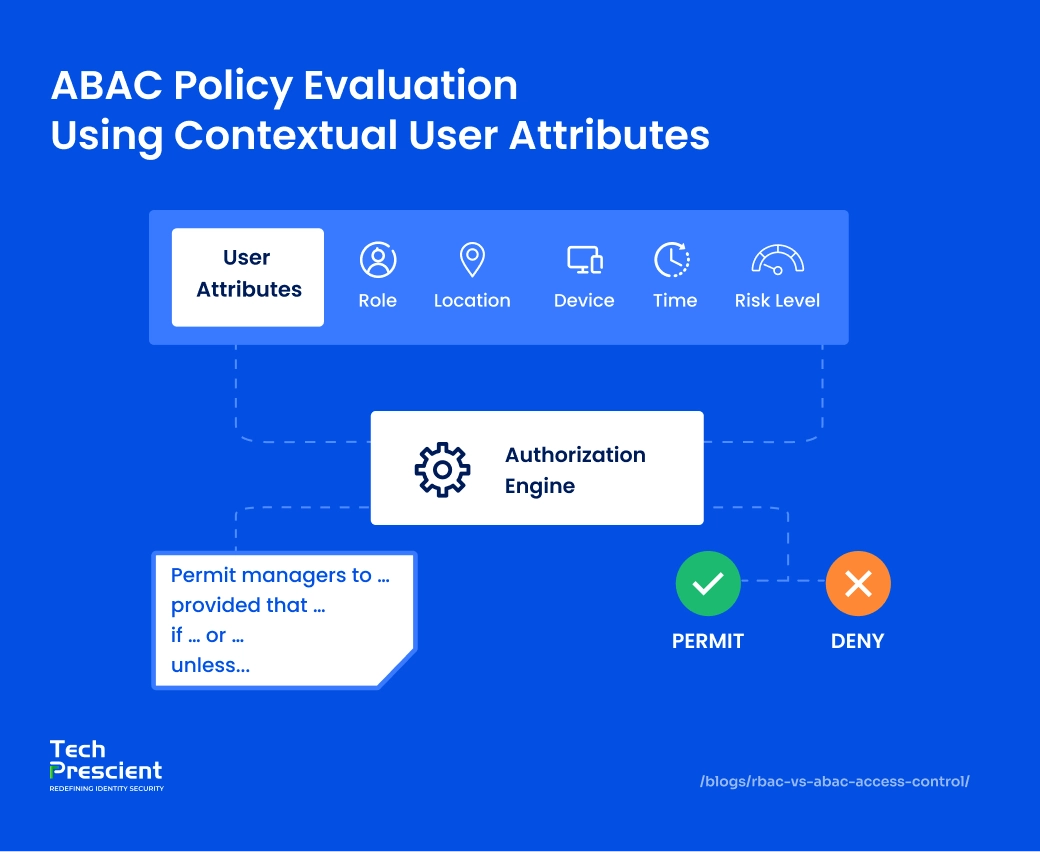
Attribute-Based Access Control (ABAC) is more dynamic and context-aware when it comes to permission settings. Instead of just assigning access based on roles, ABAC evaluates multiple attributes, which are properties or characteristics, when granting or denying access.
These attributes can be broken down into:
- User attributes - Department, security clearance level, job title
- Environmental attributes - Time of day, location, type of device
- Resource attributes - Document classification, data sensitivity, system type
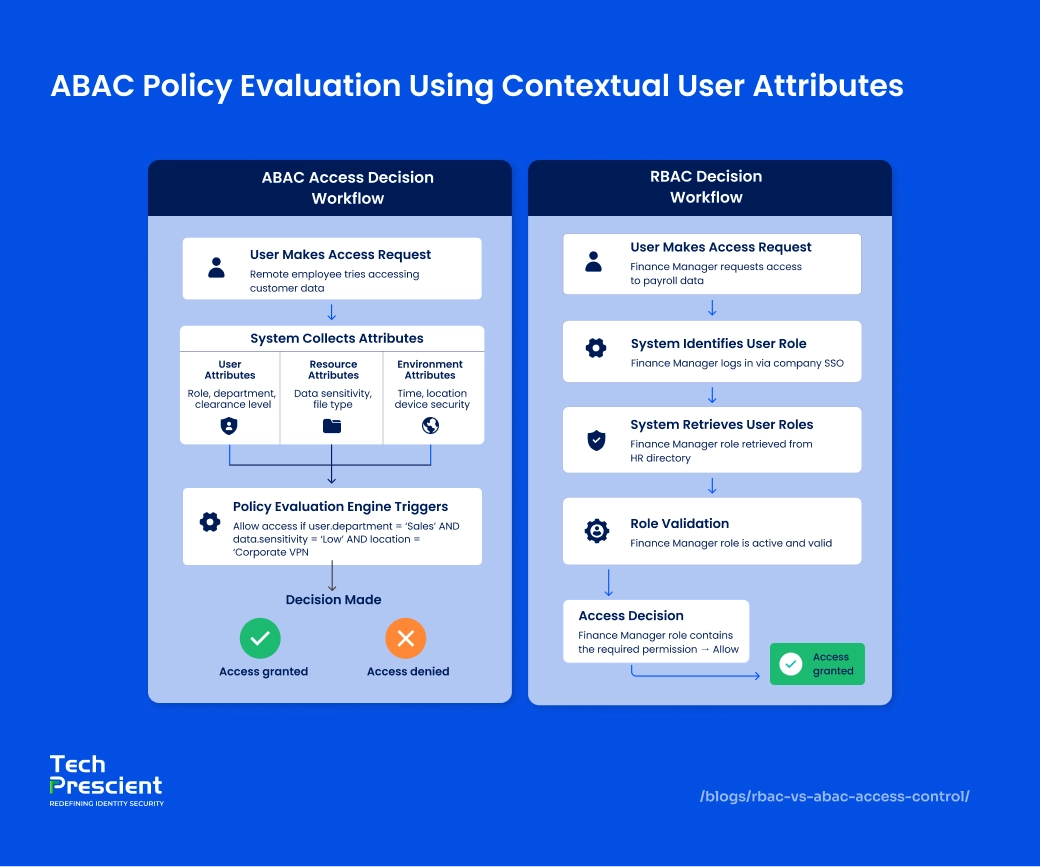
For example, a policy may state, “Allow access to Financial records only if the user is from the Finance department, connecting from the corporate network during business hours, and document sensitivity level matches user security clearance.”
Since ABAC takes real-time context into account, it allows highly granular and flexible policies, well-suited for Zero Trust, hybrid, or multi-cloud environments. It can enforce policies that change as each situation unfolds, such as denying access if a login attempt is made from an unusual location or outside of business hours.
The primary trade-off is complexity. To be successful, you need a strong understanding of the attributes used in the policy, trusted data sources to provide the attributes, and clearly defined policies. While ABAC offers greater flexibility than RBAC, it requires stronger governance maturity and more advanced tooling to operate effectively at scale.
How RBAC and ABAC Support Zero Trust Architecture
RBAC and ABAC play different but complementary roles in Zero Trust architectures. RBAC establishes a trusted baseline by assigning access based on job function, while ABAC continuously evaluates context to determine whether access should be allowed, restricted, or revoked in real time.
Zero Trust Architecture (ZTA) embraces the principle that one should never trust, but always verify. This means granting permission only based on least privilege and always verifying that the identity and context have not changed. Role-based access control (RBAC) and attribute-based access control (ABAC) are two key methods to support ZTA.
RBAC is used to provide the minimum baseline of trusted access by assigning permissions based on the user’s role. This provides a new user starting out with a minimum baseline of controls, thus limiting the number of excessive permissions a user can be given on day one.
ABAC continuously evaluates contextual factors such as geolocation, device health, and data sensitivity to ensure access remains appropriate as conditions change. This approach allows a strong verification of a user, but also allows that verification to happen again if the context changes.
The hybrid RBAC–ABAC model is becoming the most common and effective way to operationalize Zero Trust within organizations. Using RBAC as a foundational model provides structural clarity, while ABAC layers contextual controls to support cloud, hybrid, and remote-first environments without sacrificing security.
RBAC vs ABAC: Key Differences Explained
Both RBAC and ABAC are security and access control mechanisms, but their approaches to security differ significantly. The table below examines these models against important criteria to help you determine which model or models may be best suited for your organization.
| Criteria | RBAC (Role-Based Access Control) | ABAC (Attribute-Based Access Control) |
|---|---|---|
| Access Mechanism | Based on predefined roles (e.g., Admin, HR, Sales) mapped to specific permissions. | Based on attributes such as user role, department, device type, location, time, and data sensitivity. |
| Flexibility | Moderate as changes require updating role definitions. | High as policies adapt dynamically to changing attributes and contexts. |
| Granularity | Coarse-grained — permissions are tied to broad roles. | Is fine-grained. Policies can apply to individual resources and contexts. |
| Ease of Implementation | Easier to set up in structured organizations with stable roles. | More complex to design and maintain due to the number of attributes and policy rules. |
| Dynamic Access Capabilities | Access is limited. Roles don’t automatically adapt to context changes. | It’s strong. ABAC evaluates access in real time based on the current context. |
| Scalability | Can suffer from “role explosion” as organizations grow. | Scales better by avoiding role proliferation and focusing on attribute combinations. |
RBAC vs ABAC Decision Checklist
Use this checklist to evaluate whether RBAC, ABAC, or a hybrid model best fits your organization’s scale, compliance needs, Zero Trust goals, and access complexity.
RBAC vs ABAC: Quick Decision Guide
Choose RBAC if your organization has stable roles, predictable access needs, and a focus on simplicity and auditability. Choose ABAC if your environment requires real-time, context-aware access decisions across cloud, hybrid, or Zero Trust architectures. For most enterprises, a hybrid RBAC + ABAC model delivers the best balance of control and flexibility.
When to Use RBAC vs ABAC (And When to Use Both)
The correct access control model for your organization will depend on various factors, including the size, complexity, and security needs of your organization.
Use RBAC when:
You have a relatively small number of employees, predictable or stable job functions, and well-understood roles. RBAC is best where permission can and will remain infrequent, and you are seeking an easy-to-manage and maintain access model.
Use ABAC when:
You are in a complex and rapidly changing environment (multinational enterprise, regulated industry, or cloud-native organization) where compliance, dynamic environments, and requirements for context-aware policies are the norm. ABAC under these conditions is particularly well suited where permissions need to be enabled in a real-time manner on a fine-grained level.
Use a Hybrid RBAC+ABAC model when:
You want the ease of use of role-based assignments of access items and the flexibility of attribute-based policies. The current breadth of modern identity systems typically supports blended RBAC with ABAC as a role-driven assignment system for access to resources access but independent contextual markers (e.g., time, device, location) to offer a Zero Trust-like security posture.
RBAC provides structural clarity, ABAC delivers contextual adaptability, and a hybrid model combines both to meet the demands of modern hybrid and multi-cloud environments.

Pro Tip:
Don’t pick RBAC or ABAC in isolation. Design your access strategy around your business risk and scalability needs. The best-performing security teams evolve from static role models to dynamic, attribute-driven policies without ripping out existing systems.
Real World Examples of RBAC and ABAC
The following examples show how RBAC, ABAC, and hybrid access control models are applied across industries to balance security, compliance, and operational flexibility. Access control models become easier to understand when you see how they are used. Here are three examples from the industry of how RBAC and ABAC can function alone or together to drive security.
Finance
RBAC: Access is granted based on predefined roles, such as Manager or Analyst. For example, a Manager can approve high-value transactions, while an Analyst can only review them.
ABAC: Access adds conditions. For instance, loan files over $250,000 can only be opened by a Manager in the Corporate Lending department and only during business hours, ensuring sensitive data is protected by both role and context.
Healthcare
RBAC: Medical staff, like doctors and nurses, are assigned roles in the Electronic Medical Record (EMR) system, determining what patient information they can view or update.
ABAC: Adds patient-specific and environmental conditions. For example, only the patient’s assigned care team can access their records, and only when using devices connected to the hospital’s secure network.
SaaS
RBAC: New hires are assigned an Onboarding role that automatically provides them with standard access to features they need to start working.
ABAC: Access is fine-tuned based on attributes like subscription tier, geographic location, or active license count, so certain premium features are only available to customers who meet those specific criteria.
Benefits and Challenges of Each Model
Role-Based Access Control: Pros and Cons
| Pros | Cons |
|---|---|
|
|
Attribute-Based Access Control: Pros and Cons
| Pros | Cons |
|---|---|
|
|
Hybrid Model Benefits
The hybrid model leverages the benefits of both RBAC and ABAC:
- Simplicity: Using RBAC allows for a base level of ability that's easy to assign.
- Flexibility: ABAC rules can be layered on top of RBAC to enforce context-based permissions in real-time.
- Future-proofing: The hybrid model can facilitate static role-driven governance (RBAC), along with enabling dynamic governance based on attributes (ABAC).
- Stronger Zero Trust alignment: The hybrid model can help support least privilege while verifying entitlements.
Final Thoughts: Which Is Right For You?
Choosing between RBAC vs ABAC is not about picking a single “better” model, but about aligning access control with your organization’s risk profile, scale, and security maturity. While RBAC offers simplicity and auditability, ABAC provides the flexibility needed for modern, Zero Trust environments, and for many organizations, a hybrid approach delivers the best of both worlds.
Choose ABAC if you:
- Operate in a complex, compliance-heavy, or highly regulated industry.
- Require flexibility and context-aware access that adapts to changing business needs.
- Need fine-grained, real-time control over who can access resources based on multiple dynamic factors.
- Work in hybrid or multi-cloud environments where user attributes and environmental conditions frequently change.
Choose RBAC if you:
- Are a smaller organization with well-structured and relatively static roles.
- Do not require real-time, context-based access decisions.
- Want a simple, cost-effective model that is easier to design, implement, and audit.
- Have stable business processes that don’t require frequent role or policy changes.
Hybrid Approach
- Many organizations are adopting a hybrid RBAC + ABAC model, leveraging the ease and manageability of RBAC for broad permissions while using ABAC for situational, real-time access decisions.
- This approach reduces operational friction while meeting the contextual, adaptive security needs of today’s Zero Trust environments.
For a more holistic look at how access control fits into your identity security landscape, take a look at our guide to Identity Governance and Administration (IGA) that highlights how access control models, including RBAC and ABAC, fit into identity governance across the enterprise.
Here's What Our Expert Suggests:
In fast-paced, compliance-driven environments, relying solely on RBAC can be limiting, while ABAC can often be more than teams can handle. Our experts suggest a dual approach: RBAC to provide baseline role assignments and ABAC for contextual, real-time enforcement. With Identity Confluence, organizations can centralize policy management, enforce Zero Trust controls, and govern access across the IAM stack without reengineering existing systems.
FAQ
RBAC grants access based on predefined user roles, while ABAC grants access based on attributes such as department, location, device type, and time. RBAC is static and role-driven, whereas ABAC is dynamic and context-aware.
Neither model is universally better. RBAC is easier to manage and audit, making it ideal for structured organizations. ABAC offers greater flexibility and fine-grained control, making it better suited for Zero Trust and cloud environments.
Yes. Many organizations use a hybrid RBAC + ABAC model, where RBAC provides baseline access and ABAC enforces contextual, real-time policies. This approach balances simplicity with stronger security controls.
ABAC can be more secure in dynamic environments because it evaluates real-time context before granting access. However, without strong governance, ABAC policies can become complex and harder to audit.
Organizations typically move toward ABAC when they adopt Zero Trust, expand into hybrid or multi-cloud environments, or require fine-grained, policy-driven access decisions that RBAC alone cannot support.
Share



Rashmi Ogennavar
Content Writer
Content Writer simplifying IAM and governance concepts.
Most Popular Blogs
Identity ManagementUser ProvisioningAccess ControlDeprovisioningIAMIGACybersecurityRole-Based Access· 24 min read
What Is User Provisioning? Full Guide for 2026
User provisioning is key to secure account access. Learn its meaning, process, automation tools, and best practices for 2026 IAM success.
Yatin Laygude· April 29, 2026

Identity Security· 33 min read
What Is an Orphaned Account? Definition, Risks & Fixes
Orphaned accounts are hidden cybersecurity risks. Learn what they are, how they arise, and how to eliminate them securely with IAM best practices.
Brinda Bhatt· May 26, 2026

Identity Security· 24 min read
RBAC Best Practices for Enterprises: How to Implement Secure Role Models at Scale
Discover top RBAC best practices to secure systems, reduce over-permissioning, and enforce least privilege in identity security.
Yatin Laygude· May 14, 2026