
What Is Identity Lifecycle Management (ILM)? Complete Guide for 2026
Last Updated date: April 16, 2026
On this page
Automate Identity Lifecycle Management
See how Identity Confluence handles joiner, mover, and leaver workflows end-to-end.
Identity Lifecycle Management (ILM) governs digital identities from hiring (onboarding) and role changes to termination (offboarding) across their entire lifecycle, ensuring access always aligns with role, risk, and business need. If an organization can perform each one of these phases in a secure and automated fashion, it helps to limit risk, enhance compliance, and streamline access to systems.
Identity Lifecycle Management (ILM) addresses this challenge by providing a structured, governance-driven approach to managing digital identities. It governs every step of an identity's lifecycle inside and beyond your digital environment, including provisioning, role changes, and deprovisioning. However, this should not be viewed solely as a technical process; it is a deliberate approach to identifying, connecting, and governing people, technology, and permissions within a consistent, secure environment. This forms the foundation of a secure and efficient identity and access management lifecycle.
The downside is that many organizations are still hampered by silos of IAM tools or outdated manual processes from a predigital time, leaving opportunities for manual errors and increased operational risk. Modern ILM platforms address this gap by introducing structured, policy-driven automation across the identity lifecycle.
In modern enterprises, weak identity lifecycle controls are a leading cause of orphaned accounts, audit failures, and insider risk.
Key Takeaways
- Understand the key phases of identity lifecycle management.
- Learn about identity lifecycle management tools and automation benefits.
- Discover best practices for secure digital identity lifecycle management.
What Is Identity Lifecycle Management and Why It Matters
Identity Lifecycle Management (ILM) is a governance-driven framework that ensures identities receive the right access at the right time and lose it when no longer needed. The people and things managed under ILM can include employees, contractors, freelancers, third-party vendors, and also non-human entities, like bots, APIs, and IoTs. In the increasingly complex digital world of 2026, ILM is foundational to ensuring secure and controlled access to resources across cloud platforms, physical infrastructure, and hybrid ecosystems.
Unlike traditional Identity and Access Management (IAM) systems, which focus on authentication and authorization, ILM takes a full identity lifecycle view. It acknowledges that identities are dynamic. People come into the company, move into different roles, take on different responsibilities, and so on until they leave or get fired. In many situations, machine identities can spin up and down in as little as seconds and are able to operate at scale in cloud native or application-centric environments. ILM ensures that all of these changes are reflected in access permissions accordingly and accurately, forming a robust identity governance lifecycle.
Is Your Identity Lifecycle Built For Scale Or Just Survival?
Evaluate your lifecycle and machine identity governance.
What gives ILM its strength is aligning HR events (for example, onboarding, promotion, or termination) with corresponding IT actions (for example, provisioning or revoking access). This establishes a governance model where driven by the organization's business logic, security protocols can align, and compliance becomes a by-product of good design. This end-to-end process represents the core of the identity lifecycle management process.
We’ll unpack this even further in the next section when we examine the various identity lifecycle management phases and how they connect to form a dynamic, secure, and auditable identity management environment.
Key Phases of Identity Lifecycle Management
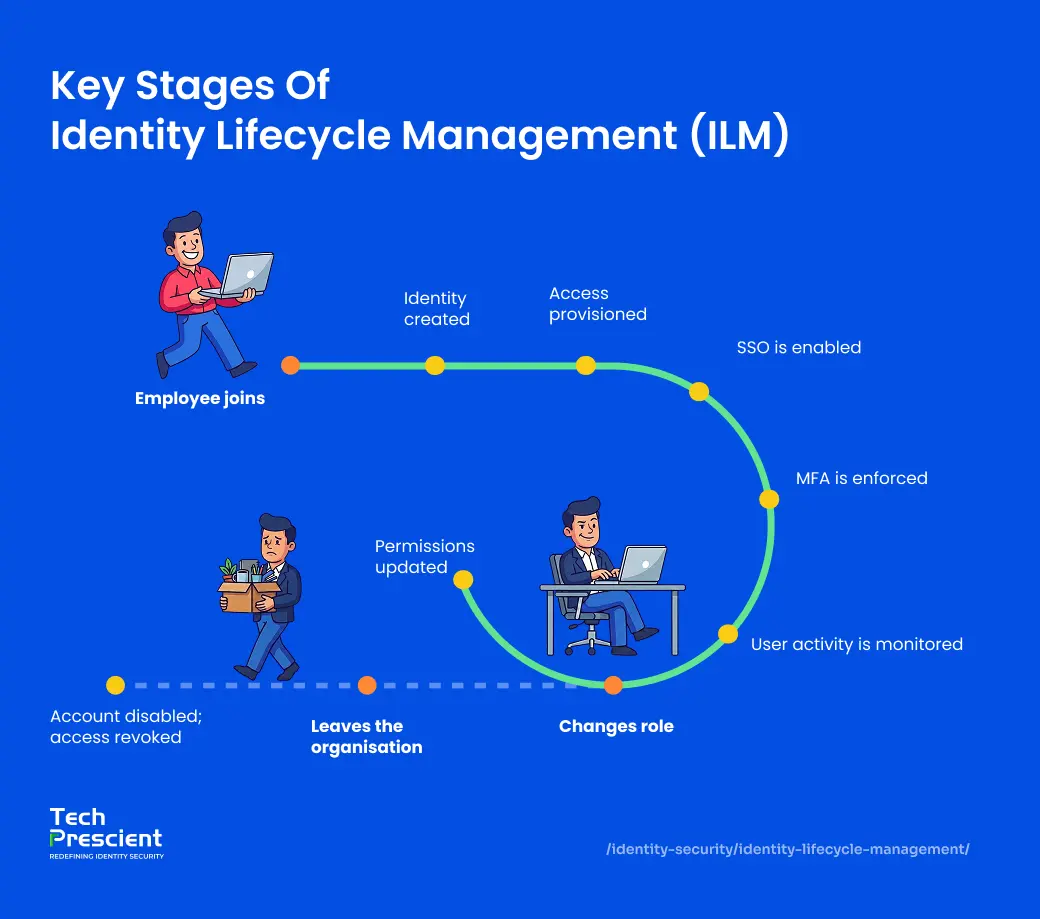
The identity lifecycle consists of defined phases that determine how access is granted, adjusted, and revoked as identities change over time. When organizations recognize and understand these important phases of identity lifecycle management, they can develop a straightforward, auditable, and secure identity governance lifecycle that is governed by business logic that reduces risk across Joiner-Mover-Leaver scenarios.
Identity Creation and Provisioning
This first stage will begin with a moment when a user has first been identified in the organization's HR system, typically upon a hiring or onboarding event. This is the moment the ILM platform has been activated, creating a digital identity with a unique user identifier. This identity is more than a username; it maps the user to a business role, job function, department, and other contextual attributes required for access decisions. At this stage, the system provisions what are sometimes referred to as "Birthright Access."
These are the essential tools and platforms for the individual to be able to perform the essential tasks they need to perform from day 1, like email, internal communication apps, department-specific applications, and shared drives. All of this is automated and occurs in real-time, and at no time did even a single helpdesk ticket need to be raised. This phase exemplifies effective identity provisioning and deprovisioning within a user lifecycle management strategy.
Practical Analogy: This is comparable to issuing a digital badge-granting system access aligned to role and responsibility from day one.
Identity Management and Access Control
As users progress through their tenure at an organization, their roles often change. They may join new teams, receive promotions, transfer departments, or take on temporary assignments. Each of these scenarios creates new access requirements while also removing others. If the access landscape is not actively managed, we can quickly find ourselves with overprivileged users and exposure to risk.
Modern ILM solutions address this problem by offering fine-grained access models, such as Role-Based Access Control (RBAC), Attribute-Based Access Control (ABAC), or some combination of these. These models allow a system to modify access seamlessly for users based on updates to their profile attributes (e.g., title, department, location). The result is that access is always context-based, appropriate based on the role, and aligned to business rules. This is a key part of an automated identity lifecycle management strategy
Real-World Example: When a sales representative is promoted to regional sales manager, their permissions to an RBAC system would change automatically. They gain access to advanced analytics dashboards and regional sales data, while access to entry-level sales tools is revoked.
Identity Modification and Role Changes
This phase covers the fluid middle ground where users require temporary access, special rights, or entitlements for project-based needs. It is also frequently where things start to go awry. Without strong controls over the lifecycle of access, users can build up access rights over time, a phenomenon known as "Access Creep."
An advanced ILM platform mitigates this by applying automation and governing rules. It keeps track of every change in access, has those tied to business justification, and builds in time limits or review cycles. In other words, temporary access expires automatically, unless assessed or renewed. These checks are essential within a healthy user lifecycle management structure and must support Joiner-Mover-Leaver workflows.
Expert Insight:
The real value of automating role changes isn't speed; it's control. Automation ensures access stays aligned with job responsibilities, reduces insider risk, and preserves audit integrity. Manual, spreadsheet-driven processes simply can't keep pace with modern identity governance requirements.
Identity De-provisioning and Retirement
De-provisioning is likely the most important and least acknowledged step in the identity lifecycle. When an employee leaves a company or a contractor finishes a project, you must revoke access immediately. Delays in de-provisioning generally lead to orphaned accounts and profiles that often become prime targets for attackers once left unmanaged.
Identity lifecycle management (ILM) platforms are closely connected to HRMS and ticketing systems. Most ILM platforms can detect termination events in real time and automatically trigger comprehensive deactivation across SaaS, on-prem, and cloud systems. This improves security posture while supporting licensing accuracy and compliance hygiene across the identity and access management lifecycle.
Is Your Identity Lifecycle Built For Scale Or Just Survival?
Evaluate your lifecycle and machine identity governance.
Essential Identity Lifecycle Management Tools
Industry experts agree that an ILM architecture must balance coverage and flexibility. Industry analysts such as Forrester emphasize moving from rule-based IAM toward policy-driven, automated identity lifecycle controls.
Recommended Tools for 2026:
- HRMS & Directory Integrations: For real-time identity triggers (e.g., Workday, SAP, AD).
- Role & Policy Engines: To assign access based on job functions and contextual rules.
- Automated Provisioning Frameworks: To eliminate manual onboarding and offboarding.
- Audit & Compliance Dashboards: To generate logs, reports, and certifications.
- Risk-Based Intelligence: Leveraging AI/ML to flag anomalies and detect access misuse.
- Self-Service Access Management: Empowering users to request or renew access with approval workflows.
At Tech Prescient, our Identity Lifecycle Management (ILM) solution reframes how organizations manage their human and non-human identities across their digital enterprise using a modern, policy-driven approach with pre-configured automated provisioning and risk-based intelligence to reduce program governance overhead and proactively manage enterprise security and compliance risk at scale.
ILM for Non-Human Entities
With organizations moving to more digital processes, machine identities are becoming just as essential and just as dangerous as human identities. From bots and APIs to service accounts and containers, non-human entities are now powering the vast majority of backend processes. But lacking governance, they often are invisible and uncontrolled by IT teams, which can make machine identities very risky. This is why managing machine identities must be an integral aspect of an identity lifecycle management approach.
Managing Machine and Device IdentitiesToday's organizations are adopting automation and scaling digitally, which means non-human identity types (IoT, bots, service accounts, containers, APIs, etc.) are everywhere - and generally outnumber humans in many environments. These machine identities are completing critical business functions like transferring data, automating processes, and enabling app-to-app communications. Regardless, these machine identities are becoming an increasing security and compliance risk when not managed.
In many organizations, machine identities have been excluded from IAM activity, creating gaps in visibility, orphaned credentials, and elevated privilege without governance - which adversaries will exploit. This is why ILM or Identity Lifecycle Management strategies in 2026 will require the same level of diligence and governance for non-human entities as for human identities.
An effective ILM platform should:
- Automatically create and tag machine identities: Anytime new API keys are generated for DevOps tasks or services (e.g., a new bot account to automate customer support), the process should automatically enroll the entity, ingest metadata (owner, purpose, expiration), and apply scoped access policies.
- Issue time-bound credentials and API tokens: Credentials to machine identities must also be limited in duration (short-lived) and automatically rotatable. Temporary tokens should expire in hours or days, depending on context, with renewal only upon validation and logging. This guarantees ephemeral access and reduces persistent exposure.
- Deactivate or archive inactive entities: Machine identities that exceed their defined inactivity period (e.g., 30, 60, or 90 days) should trigger an automated review or safe removal. This removes dormant access and reduces credential-compromise risk.
Scenario: Assume we have a CI/CD pipeline that requires an API key to deploy a container into production. Bear in mind that it is normally inappropriate to give an API key with no expiration. An example of the ILM platform would be provisioning a key that had a 72-hour expiration period, linking it to the project, and logging utilization. If the project extended beyond 72 hours, the team would have to request approval for another key provisioning. Once expired, the key would be automatically revoked and archived.
Why It Matters: As cyber threats are now targeting overlooked vectors like machine accounts, it is essential to apply lifecycle governance to these non-human identities. Orphaned service accounts, hard-coded credentials, and non-expiring access tokens are common funnel points during security breaches. Managing non-human identities in ILM not only closes access gaps but also assures audit readiness and operational integrity across automated processes.
Benefits of Effective Identity Lifecycle Management
A successful ILM implementation isn't just a win for your IT department; it's a strategic win for your whole organization. Here is the summary of how a successful ILM system affects more enterprise performance areas:
- Enhanced Security Posture: By enforcing need-to-know and time-bound access through Identity Lifecycle Management (ILM), the organization significantly reduces its attack surface. ILM limits access sprawl by strictly enforcing policies that expand or revoke access rights when users move through multiple roles or exit the organization. This greatly minimizes the likelihood of misuse or unauthorized access on the inside or outside.
- Audit Confidence Increased: Compliance is more than a checkbox exercise at an organization. An organization requires verifiable, traceable evidence of governance. ILM platforms store audit logs associated with every identity action, access grant, change, or revocation. When audit season approaches, security and compliance teams have everything necessary to demonstrate policy compliance for any piece of regulation, starting with SOX through GDPR.
- Improved Operational Efficiency: With ILM, users never have to wait for IT to manually add access. Rather, everything is automated in real-time, be it provisioning on Day 1 or revoking when someone is offboarded. This means less downtime, quicker ramp-ups to productivity, and easier role transitions, whether you’re moving to a different project or department.
- Reduced IT Workload: Helpdesk teams are often overwhelmed with the number of access-related requests. ILM systems eliminate, streamline, and automate these requests so the IT team can focus on more strategic items like improving architecture or security. When users can self-service their access request, and not wait for terms of approval, your need for user intervention significantly reduces.
- Improved Employee Experience: Smooth access leads to smooth workflows. Users receive appropriate access at the right time, and no employee will waste time waiting on overly complicated approvals or delay steps that bottleneck workflows. Pre-defined access policies are attached to roles, so users get what they need without wasting more time and emails on additional requests or approvals. This gets and keeps trust in the IT function, along with more employee satisfaction and productivity.
Insights That Matter: ILM Platforms are not merely reactive; ILM platforms are predictive. The difference can be found with real-time dashboards, surface anomalies, and trends such as
unused entitlements, segregation of duties (SoD) violations, and overprivileged accounts.
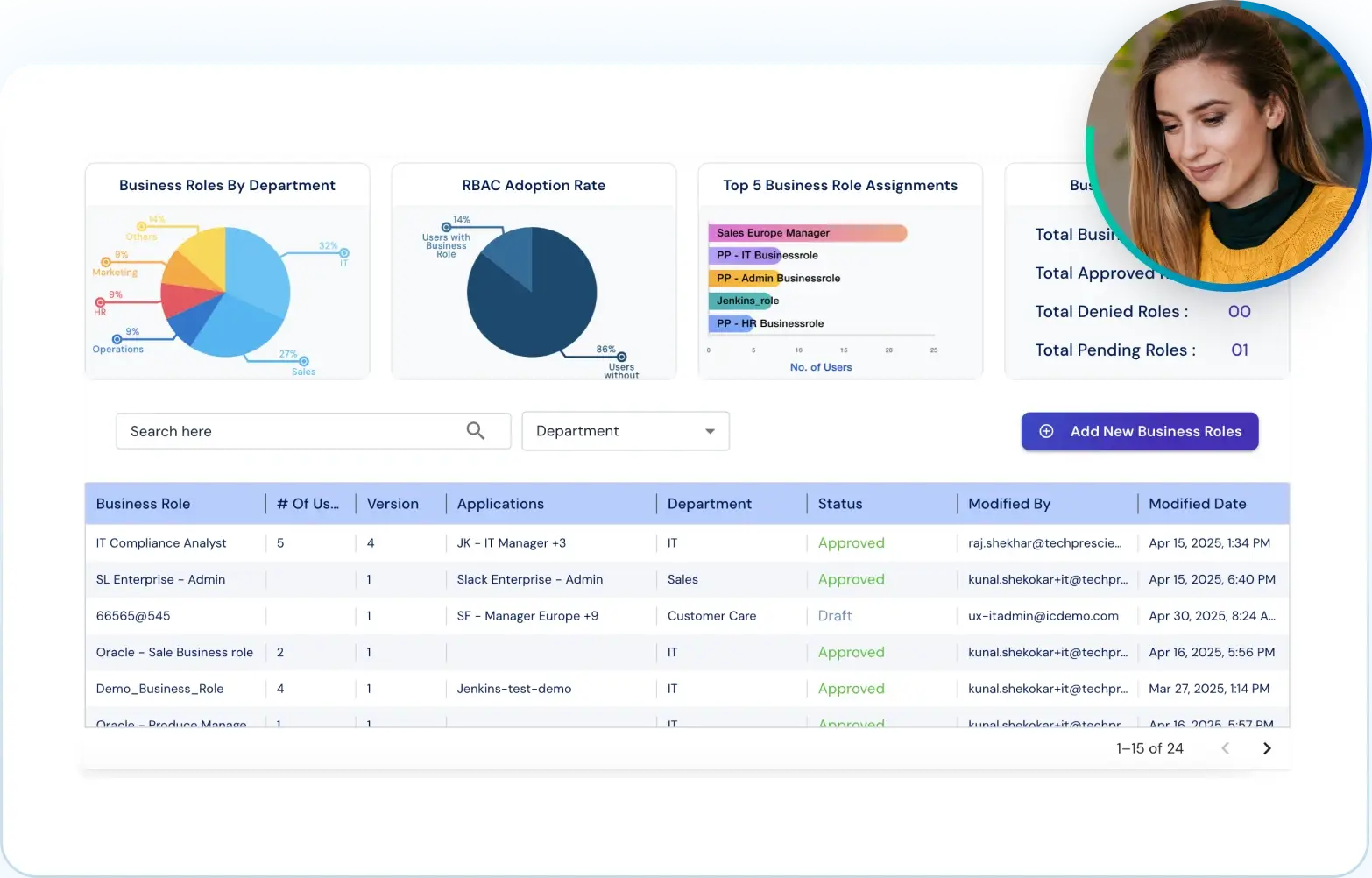
The visibility from dashboards enables organizations to continuously monitor and better understand risk across many variables and refine access strategies around actual usage and risk patterns.
Best Practices for Implementing ILM
Deploying ILM within your organization will involve more than just turning on the switch and flipping the lever. Success requires thoughtful design, collaboration with the stakeholders, and a mindset that expects the future. Here are some best practices that will drive success and future sustainability:

Anchor workflows in your HRMS
Your HR system should be the system of record for identity events like onboarding, transfers, and terminations. Integrating ILM with systems such as Workday or SAP to trigger identity change based on confirmed business processes is paramount. The use of your HR system eliminates three factors in the traditional access management process: manual input, reducing human error, and aligning identity governance to business change and people.
Define and maintain business roles
Moving from access management for individual user access to definitive business roles, as in let’s say "Sales Associate" with policy-based access to CRM, email, and sales analytics tools. When users are assigned or moved into that definitive role, their organizational role automatically updates. This role-based structure improves management efficiency and scales with your growth.
Use visual policy builders
Traditional access management policies can be buried in code or broadsheets. A visual policy builder will enable security teams, IT admins, and auditors to easily consume, review, and edit policies. Greater exercising will lead to greater transparency, quicker approval cycles, and accessibility for non-technical stakeholders in following governance rules and meeting compliance obligations.
Include non-human identities in lifecycle governance
Machine identities (bots, IoT devices, service accounts) are often an afterthought when considering access. Machine identities also need lifecycle controls along the same parameters as a human user - autogenerated provisioning, expiration timelines, and vendor monitoring. Including substantively aligned machine identities as part of your ILM strategy ensures you're covered and minimizes hidden costs.
Automate continuous certification
Annual access reviews are fundamentally insufficient given today's tech-accelerated environment. Automating periodic certification campaigns - e.g., quarterly certification for 6 months of the year provides an opportunity to review and validate access privileges on an ongoing basis. Intelligent workflows and analytics can notify reviewers of anomalies and recommend revoking privileges for inactive accounts, with actions documented to support compliance.
Centralize logging and reporting
A mature ILM space displays a single pane of glass to view all things dispositioned by identity. This includes access, approval processes, policy rules changed, decisions made for compliance reviews, etc. Centralized logging creates accountability and collectively expedites audits, compliance inquiries, and engagement with regulators. Exportable logs and audit trails are especially critical for meeting standards like SOX, HIPAA, and ISO 27001.
Is Your Identity Lifecycle Audit-Ready?
Find out if your controls, tools, and governance align with ILM best practices.
FAQs
While IAM (identity and access management) emphasizes the facets of authentication (verifying who you are) and authorization (defining what you can access), ILM considers the entire identity lifecycle: building that identity, provisioning access, changing access when the role or department changes, and finally, securely offboarding. ILM interacts with contextual governance, workflow tasks, and auditing to ensure continued appropriate access rights throughout the identity lifecycle.
While identifying and validating identities, via Single Sign-On (SSO), and accessing with Multi-Factor Authentication (MFA) are key components to the login process, these aspects do not address management access, especially when roles change over time, or a change is warranted. With ILM, entitlements will ensure business roles provide appropriate entitlements access, there is automation in the update of access, and users are immediately denied access when no longer needed. Essentially, ILM provides an operational, governance layer above SSO and MFA.
When comparing against industry benchmarks, organizations that have deployed automated ILM solutions are seeing benefits including 30-50% decreases to onboarding times, 60-70% decreases in helpdesk tickets related to access, and faster compliance work. These are all benefits that have a measurable cost savings and productivity impact. Most organizations are realizing their return on investment (ROI) between 12 and 18 months after deployment.
ILM solutions connect with cloud-native apps, HRMS systems and identity providers to help automate provisioning and de-provisioning workflows for users across geographies and time zones. Whether the user is remote, freelance, or part-time, ILM ensures the user gets the right access on day 1 and loses access immediately upon exit. Both of these capabilities are critical for compliance and cybersecurity, especially in a remote-first world.


GET A PERSONALIZED DEMO
See Identity Confluence in Action
“One platform to govern identities, automate access decisions, and prove compliance; across every app, user, and system in your environment.”



Murli Ramsunder
Senior Architect, Vonage