
IGA vs IAM: What's the Difference and Why It Matters in 2026
Last Updated date: July 6, 2026
On this page
See Tech Prescient in Action
Automate access, reduce risk, and stay audit-ready
Identity and Access Management (IAM) and Identity Governance and Administration (IGA) are often confused, but they solve very different problems. IAM focuses on enabling and enforcing access, while IGA ensures that access is appropriate, justified, and continuously governed.
IAM controls who can log in and what they can access. IGA governs why that access exists, whether it should continue, and whether it meets security and compliance requirements.
In this blog, we'll explore how IAM and IGA differ, how and where they work together, and how to integrate them in your identity security strategy.
Key Takeaways:
- IAM manages authentication, authorization, and user access.
- IGA governs access by enforcing policies, reviews, and compliance controls.
- IAM is operational and access-focused; IGA is strategic and governance-driven.
- IAM answers "who can access?"; IGA answers "should they still have access?"
- Together, IAM and IGA support least-privilege access and Zero Trust security.
What is IAM (Identity and Access Management)?
Identity and Access Management (IAM) is a security framework that authenticates users and controls their access to systems, applications, and data. IAM ensures that the right identities can log in and perform permitted actions using mechanisms such as authentication, authorization, SSO, and MFA.
Identity and Access Management (IAM) is the foundational system that verifies user identities and manages access across an organization's applications, systems, and data.
At its core, IAM answers two important questions for any organization: Who are you? And what are you allowed access to? It makes sure that the right users, be it employees, contractors, or systems, gain the appropriate access to the right resources, streamlining your workflow and strengthening security.
For example, an employee may use SSO to access internal tools, with MFA applied when accessing sensitive applications or data.
Key functions of IAM:
- User provisioning and deprovisioning
- Authentication and authorization
- Single Sign-On (SSO)
- Multi-Factor Authentication (MFA)
IAM is essential for modern enterprises operating across cloud, SaaS, and hybrid environments. However, without clear role definitions and ongoing access oversight, IAM alone can introduce over-permissioning and audit gaps. IAM implements strict access control and monitors user activity, reducing the risk of data breaches, simultaneously increasing operational efficiency and cutting IT overhead.
Common IAM solutions would include Okta, Azure AD, and Tech Prescient, offering robust features, making identity management seamless and secure.
What is IGA (Identity Governance and Administration)?
Identity Governance and Administration (IGA) is the governance layer that ensures access granted through IAM remains appropriate, compliant, and justified over time. While IAM enables access, IGA determines whether users should have that access in the first place, and whether it should continue.
IGA governs the full identity lifecycle by enforcing access reviews, segregation of duties, policy-based provisioning, and audit reporting. It ensures organizations remain compliant, reduce insider risk, and maintain visibility into who has access to what and why.
IGA governs the Identity Lifecycle by enforcing policy-based access, validating entitlements over time, and ensuring access remains aligned with business and regulatory requirements. For example, when a finance team requires elevated access during a quarterly close, IGA can enforce time-bound access and trigger periodic recertification to ensure permissions remain justified.
Key functions of IGA:
- Access certifications and periodic reviews
- Role-based access control
- Segregation of Duties
- Policy-based provisioning and deprovisioning
- Audit and compliance reporting
SailPoint, Saviynt, and Oracle Identity Governance are leading platforms offering IGA tools with rich capabilities across hybrid and multi-cloud environments.
Core Principles of Zero Trust Architecture
Zero Trust architecture depends on both IAM and IGA. IAM verifies identity and enforces access in real time, while IGA ensures that access policies align with business rules, risk posture, and compliance requirements. Together, they operationalize the principle of never trust, always verify.
In a Zero Trust model, access is continuously evaluated based on identity, context, and risk, rather than granted once based on credentials alone. In such a framework, trust has to be continuously earned, evaluated, and authenticated. This aligns tightly with both IAM and IGA by implementing least privilege access, constant authentication and authorization, and detailed policy enforcement.
Here's how the core principles play out:
Verify Explicitly This means making use of all available data and not just your credentials for authorization and authentication of every request.
Access decisions are based on signals such as:
- User identity and role
- Device health and security posture
- Location and time of access
- Sensitivity of the requested resource
- Risk scores and behavioral patterns
For example, even if a user logs in successfully, they would still need multi-factor authentication (MFA) to access any sensitive financial data, especially if the login is from an unrecognized device or location.
This constant verification warrants that the access is always intentional, contextual, and secure.
Key Differences Between IAM and IGA
The key difference between IAM and IGA is scope and purpose. IAM focuses on granting and enforcing access, while IGA focuses on governing and validating that access over time. IAM ensures users can access systems securely, while IGA ensures that access remains necessary, compliant, and governed over time.
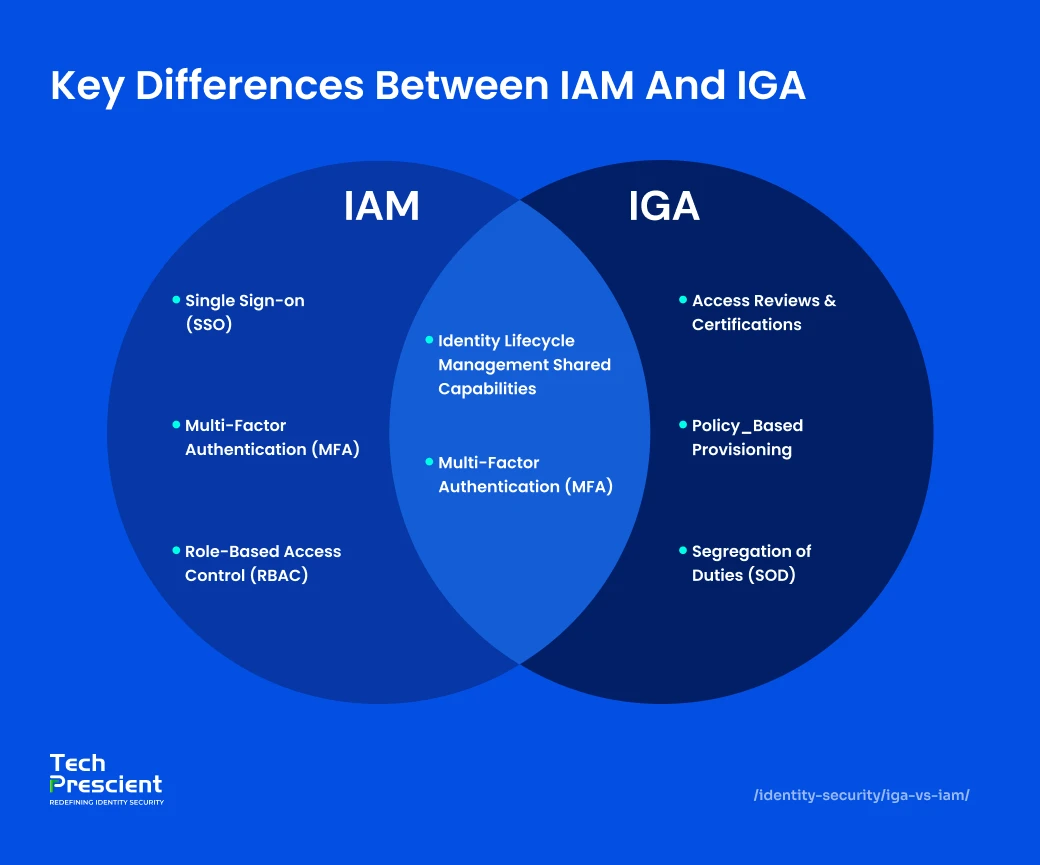
| Feature | IAM | IGA |
|---|---|---|
| Purpose | To provide authentication, authorize access, and control it | To ensure access policies are compliant, enforce policies, and review access |
| Scope | Focuses on Operational systems [day-to-day access] | Focuses on Strategic systems [policy, audit, compliance] |
| Automation | SSO, Authentication, and User Provisioning | Access reviews, policy enforcement, and deprovisioning |
| Tools | Okta, Azure AD, OneLogin | SailPoint, Saviynt, Oracle Identity Governance |
| Objective | To secure access for users and apps across platforms | To ensure access is appropriate, auditable, and policy-driven |
Implement IAM and IGA together correctly
Use this checklist to integrate IAM and IGA without overlap, access gaps, or audit issues.

Governance and Compliance
Identity Governance is the fundamental layer that enforces security policies, ensures compliance, and reduces the risk of access misuse. While IAM systems control access, they do not provide the governance needed to justify, review, and audit that access over time.
IGA solutions fill this gap by enabling:
- Access certifications to validate entitlements
- Segregation of Duties (SoD) policies to avoid conflicts of interest
- Audit records for every approval, request, or change
For industries like Finance, Healthcare, and SaaS, where compliance is non-negotiable, this governance is crucial.
Risk Management and Audit Readiness
IGA sets your organization up to prove that all access given is compliant and appropriate, while IAM enforces access at runtime.
IGA strengthens risk posture by:
- Spotting over-provisioned accounts
- Flagging orphaned or dormant identities
- Automating risk scoring based on access sensitivity
- Offering detailed audit logs for regulators and internal audits
IGA makes certain that identity-related risks are well-documented, monitored, and remediated, whether it's SOX, HIPAA, GDPR, or any internal governance frameworks.
Lifecycle vs. Policy-Driven Access Control
IAM takes care of the identity lifecycle by provisioning and deprovisioning users, enabling login access, and streamlining the workflow. But IGA governs access throughout that lifecycle with the right context and control.
IAM handles:
- Onboarding users and enabling SSO
- Setting basic access permissions
- Disabling accounts on offboarding
IGA adds:
- Policy-based provisioning (e.g., only finance users get ERP access)
- Periodic reviews of access
- Automated revocation if policy conditions change
They ensure that access is granted immediately, but only when it's suitable and only for as long as it's required.
Why You Need Both IAM and IGA
IAM and IGA are not interchangeable; they are complementary. IAM enables day-to-day access so work can happen. IGA ensures that access is governed, reviewed, and aligned with security and compliance requirements. Relying on IAM alone creates blind spots that only IGA can address.
IGA and IAM are two halves of a comprehensive identity security strategy. Without IAM, everyday operations would come to a stop, resulting in a loss of productivity and serious security risks. While IAM can ensure that users can access the right systems, it doesn't validate why they should do so.
That's where IGA steps in. It builds structure and keeps IAM in check by enforcing access policies, setting up periodic reviews, and ensuring segregation of duties. Together, they create a resilient and responsive identity fabric.
For Example: In a healthcare environment, IAM enables staff to authenticate securely, while IGA ensures access is limited to assigned patients, restricted to active shifts, and automatically updated when roles change. This supports HIPAA compliance while reducing exposure to sensitive data.
Regulations like GDPR, SOX, HIPAA, and ISO 27001 require access to be justified, reviewed, and auditable. These demands can't be fulfilled by IAM alone without IGA's built-in controls, such as policy enforcements, access certifications, and audit reporting.
Expert Insight
Organizations that rely on IAM alone often pass audits once but fail them later. IGA is what sustains compliance over time by continuously validating and governing access as roles, risks, and regulations change.
Use Cases: IAM vs IGA in Action
Across industries, both IAM and IGA play fundamental but very different roles in solving identity-related challenges. Here's how they show up in the real world:
Finance:
IAM enforces multi-factor authentication (MFA) for employees to access banking systems and internal resources. IGA implements Segregation of Duties (SoD) to ensure no one user can initiate and approve the same financial transaction, curbing fraud risk and enabling SOX compliance.
Healthcare:
IAM ensures only authorized personnel can log into Electronic Medical Records (EMR) and access sensitive patient data. IGA automates these access reviews for HIPAA compliance, ensuring this access is maintained only for as long as it is required.
SaaS Companies:
IAM automates user provisioning and SSO, speeding up the onboarding process and granting access to necessary internal tools. With IGA, the company has visibility into license sprawl and any unused access. This ensures proper deprovisioning when employees resign or change roles.
What do these use cases reinforce?
The distinction is straightforward: IAM enables access, and IGA governs it. Together, they create a secure, compliant, and efficient identity environment regardless of the industry.
Best Practices for Implementing IAM & IGA Together
Integrating IAM and IGA ensures scalable, secure, and compliant identity management systems. Here's how you can implement them to get the most out of your security systems:
Define roles & policies precisely
Start with clearly defined roles and access policies. Define the user roles based on their function and not titles. Use Role-Based Access Control (RBAC) to map out what each role should access. This ensures a strong foundation for IAM provisioning and IGA governance to be implemented.
Automate JIT (Just-in-Time) access and deprovisioning
JIT provisioning guarantees users only get access when they need it and only for as long as it is required. Organizations should avoid standing access wherever possible. This reduces the risk of orphaned accounts as automated deprovisioning kicks in to remove access when it is no longer needed.
Best Practice
If access doesn't expire by default, it isn't truly governed. Pair Just-in-Time access with automatic expiry and recertification to prevent standing privileges from quietly becoming audit risks.
Conduct regular user access reviews
Establish periodic access certifications. They can be monthly or quarterly, based on the sensitivity of the systems. Your IGA platform can track the approvals, automate the review process, and maintain clean audit trails.
Enforce least privilege
Users should only be given the minimum level of access required to perform their roles and nothing more. This significantly reduces the risk in case credentials are compromised and also helps avoid unintentional misuse of sensitive data. Enforce Zero Trust architecture using IAM and IGA.
Enable continuous compliance monitoring
Make use of IGA tools to consistently audit whether the access policies are being followed. These tools can automate policy checks, spot violations, and generate real-time reports, ensuring you are always audit-ready.
Common Pitfalls to Avoid
Even with all the right tools, your systems can fall short if some key steps are missed. Avoid these implementation mistakes that weaken your IAM-IGA architecture.
Treating IAM and IGA as interchangeable
IAM and IGA are distinct and solve very different problems. Using only one of them creates gaps and can jeopardize your security. IAM gives and enforces access, while IGA grants visibility into access and verifies if it is compliant, appropriate, and necessary.
Skipping access review cycles
Skipping certifications can cause privilege creep and compliance violations. Set up access reviews by automating periodic reviews through IGA and tying them to policy enforcement in real-time.
Over-permissioning users
Don't give standing access to users "just in case." While it may seem convenient, standing access significantly increases security and audit risk. It is also one of the most common audit failures. Ensure least privilege access at all times and use RBAC or JIT models.
Poor integration with HR systems
If your IAM and IGA systems are not integrated with HRMS or ERP, it can cause your identity lifecycle management to break down. Users will end up retaining access even after role changes or termination. Ensure real-time provisioning and deprovisioning by using SCIM or API to integrate your IAM/IGA stack with HR systems.
Ignoring governance in cloud environments
Adoption of cloud environments is on the rise with hybrid and remote workforces. They usually bypass traditional access governance systems. To ensure policy-based oversight across platforms, you can extend IGA to your cloud and DevOps environments using CIEM (Cloud Infrastructure Entitlement Management).
Choosing the Right IGA and IAM Tools
Not every IGA and IAM platform is made equal. You need to decide what is best for your organization based on how well it can integrate with the tools you use, your scalability, and compliance regulations. You need to look beyond the feature checklists to make the right choice.
So, how can you evaluate your needs?
Start with asking the right questions:
- Does it support SCIM or API-based provisioning for cloud and SaaS tools?
- How well does it integrate with our HR system or source of truth?
- Can it handle complex roles, entitlements, and SoD policies?
- What kind of audit logs, certifications, and reporting features does it offer?
- Does it support both on-prem and cloud workloads or only one?
- How quickly can we deploy, and how much customization is needed?
The right questions can help you dig into how a platform can fit into your existing ecosystem and future requirements.
On-prem vs. cloud-based IAM/IGA
On-prem tools often require longer implementation timelines and more IT overhead. They make sense if your organization belongs to a highly regulated industry with strict data residency and control requirements.
Cloud-based solutions are better suited for integrating with SaaS environments. They are faster to deploy, easier to maintain, and ideal for hybrid or remote teams.
Role of APIs and SCIM in tool compatibility
Scalable identity management today relies on open standards. Look for tools that support:
- SCIM (System for Cross-domain Identity Management) for automated user provisioning across SaaS apps.
- Robust REST APIs for custom integrations, workflows, and reporting.
- Out-of-the-box connectors for critical systems like Okta, Azure AD, ServiceNow, Salesforce, and your HRIS.
The more interoperable your IAM and IGA tools are, the smoother your identity architecture will scale across departments, clouds, and apps.
The Future of IAM & IGA in the Age of Zero Trust & AI
Digital ecosystems are becoming increasingly complex, and the traditional perimeter-based security model no longer cuts it. IAM and IGA are the foundation of Zero Trust architectures, where access is always verified and never assumed. Now with AI, automation, and cloud-native innovations shaping the future of identity security, here's what you need to watch out for:
Role of AI in identity governance:
AI and ML have become key in managing identity at scale. Why? Because manually reviewing access and enforcing policy is no longer viable.
- behavioral analytics detects inconsistent access patterns
- AI-driven recommendations can spot nonessential privileges or propose role changes
- Risk scoring enables real-time contextual access decisions
This enforces proactive governance, preventing risky access before it becomes a breach.
Cloud native identity stacks:
Cloud native identity platforms that are API-first, scalable across hybrid / multi-cloud environments, and built for decentralized workforces are being favored against legacy IAM/IGA tools. As these modern stacks integrate seamlessly with DevOps pipelines, SaaS apps, and CI/CD workflows, they make identity security a dynamic part of your infrastructure.
CIEM (Cloud Infrastructure Entitlement Management):
Cloud Infrastructure Entitlement Management fills an essential gap in identity security. It governs access to cloud platforms such as Azure and AWS, where traditional IGA tools are inadequate. CIEM helps:
- Discover dormant or excessive entitlements
- Visualize access paths across cloud accounts
- Enforce least privilege at the infrastructure level
This has become requisite as cloud environments are growing faster than most IGA policies can keep up.
Contextual access and continuous authentication:
Going ahead, access will be constantly evaluated and not just granted at login. Access will be based on real-time signals like:
- Location and device health
- Recent behavior patterns
- Session anomalies
This allows for higher security for remote teams and high-risk roles without compromising usability.
Final Thoughts
The theory is simple: IAM controls access, and IGA governs it. But in practice, they form the backbone of a strong and scalable identity strategy.
Identity security is not limited to controlling access but extends to governing it with accountability, precision, and the right foresight. But in today's threat landscape, one without either is simply not enough. As identity-based attacks continue to evolve, organizations need identity controls that scale with complexity and risk.
Unify IAM and IGA Without Complexity
Automate identity governance, access enforcement, & compliance across environments.
IAM manages authentication and access, while IGA governs whether access is appropriate, compliant, and should continue over time. IAM enables access; IGA validates and controls it.
IGA adds governance controls such as access reviews, segregation of duties, and compliance reporting on top of IAM's authentication and authorization capabilities.
IGA complements IAM by governing access granted through IAM, ensuring permissions remain justified, policy-compliant, and auditable.
Yes. IAM ensures secure access, while IGA prevents over-permissioning, insider risk, and compliance failures. Together, they form a complete identity security strategy.


GET A PERSONALIZED DEMO
See Identity Confluence in Action
“One platform to govern identities, automate access decisions, and prove compliance; across every app, user, and system in your environment.”



Murli Ramsunder
Senior Architect, Vonage